




If you are going to buy a beam for your construction project, then every beam carries a decision behind it. Choose the incorrect type of beam due to load, span, or material conditions, and you are facing structural failure, rework, or schedule delays that no schedule can accommodate.
In this article:
ToggleBehind every beam in a construction project, there is a decision. Whether you are a structural engineer, site supervisor, or construction project manager, understanding all the types of beams in construction, as they are categorized based on support, material, shape, and method of construction, is the most important part.
Here, you can find all of the 25 beam types in this guide: what they are, where they are applied, and in what conditions they are most appropriate.
You will also find a dedicated section on how beam selection affects construction project management timelines and costs.
What is a Beam in Construction and civil engineering?
What Are the Main Uses of Beams in Building Construction?
The beams in construction have four main functions, which cannot be duplicated completely by any other structural element.
1. Load Bearing
The main role of all types of beam is their supportive nature, as it may be the weight of a roof, a floor slab, equipment or live loads such as people and vehicles. This weight is distributed by the length of the beam and directed to the points of support, so there is no concentrated stress on the beam that would crack or collapse the building.
2. Preventing Deformation
Without beams, the large buildings would bend immediately after a few months of construction. Beams in building construction support the geometrical integrity of a structure by balancing loads over the entire span of the beam.
This is the reason why the perfectly constructed wall that lacks sufficient support of the beams will eventually exhibit the diagonal cracks due to the difference in stress.
3. Spanning Open Spaces
Beams enable wide open rooms, large spans. Warehouse floor, open-plan office, hospital hallway: all rely on structural beams to span the distance between supports without columns dividing the space in use.
4. Bearing Environmental and Seismic Loads.
The structures are subjected to lateral and vertical pressures due to earthquakes, wind, and seismic forces at the same time.
Beams in building construction, distribute these forces are spread out on many load paths by beams, which makes it much more difficult to identify one point of failure.
25 Types of Beams in Construction: Full Classification
Beams in civil engineering are categorized into six broad groups: how they are supported, materials used in making them, the construction method, cross-sectional shape, and the way the beam reacts when subjected to load.
Each category informs you of something different about the way a beam will perform in the real conditions.
The 25 types of beams below are grouped in all six classification systems in such a way that you can easily find out the appropriate beam type to use for any structural situation.
Types of Beams Based on Support: 8 Structural Categories Explained
The way in which a beam is supported almost entirely defines how it will act under a load: where it will bend, where stress will be concentrated, and how much load can be introduced to the beam before it fails. Structural engineering practice is based upon these eight types of support-based beam.
1. Simple supported beam:
A simply supported beam is one which is supported at each end on two supports, and there is no resistance to rotation at any end.
It is also the most popular beam in construction due to short to medium spans since it is simple to analyze, economical in materials and understood by labor in site. It curves at midspan under a uniformly-applied load, predictable and controllable.
- Real-world use: Typical floor beams in residential and commercial RCC structures, approach spans in bridge work, purlins in industrial roofs.
2. Cantilever beam:
At one end a cantilever beam is rigidly fixed and at the other end it is absolutely free. The fixed end should be able to withstand the bending moment and shear force produced by the load entirely and the free end bends down under the load.
This type of beam forms the foundation of all the balconies, overhangs and diving boards.
- Real-world use: balcony slabs in apartments and hotels, roof overhangs, canopy buildings over building entrances, approach decks in cable-stayed bridges.
3. Fixed beam:
A fixed beam is clamped at the two ends with a fixed beam. This rigidity implies that the bending moments are shared by the midspan and the fixed ends, and the deflection at the midspan is lower as compared to a simply supported beam with the same span and load.
- Real-world use: Portal frame with heavy loads in industry, reinforced concrete portal frame, structures where material economy is not of so much importance as deflection control.
4. Overhanging beam:
One of the two supports has an overhanging beam. This forms two separate structural regions: the distance between the supports acts like a simply supported beam, and the cantilevered part above the outer support generates a hogging bending moment that changes direction at the support.
- Real world applications: Roof projections beyond the outer wall, balconies with a back-span, decking of small bridges.
5. Double overhanging beam:
When a beam is double and is overhanging both its supports. The reversal of bending moments in both outer supports must be carefully calculated but the type of beam permits architectural freedom which cannot be afforded by a simple beam or a single cantilever.
- Real-world use: saw-tooth-like elements of building features, some types of bridges, canopy structures of grandstands.
6. Continuous beam:
It is a continuous beam that extends beyond two supports and in many cases beyond three, four or even more columns or piers. Since this is a continuous beam, the loads are spread over a number of spans at once, so the maximum bending moment at any one point is less than with a series of independent simply supported beams spanning the same total span.
- Real-world use: Multi-pier highway bridges, floor beams in a central corridor of a multi-bay commercial building, railway bridge superstructure.
7. Trussed beam:
A trussed beam is a traditional beam that is strengthened by a triangular truss system at the top or bottom chord. In place of a bending load in a solid web, the truss geometry applies direct tension and compression in individual members to gain very long spans with comparatively shallow depth without excessive material weight.
- Real-world use: Roof structures of large warehouses, sports arenas, factories and aircraft hangars where clear spans of 30 to 100 metres without columns are needed.
8. Plinth beam:
A plinth beam is a reinforced concrete beam that is formed at the plinth level, which is the limit between the substructure beneath the surface and the superstructure above. It is used in particular to serve as the tensile device between columns and walls at the base of the building, and to prevent the upward propagation of the cracks of different settlement of the foundation into the wall structure.
- Real-world use: Standard in Indian load bearing and framed construction, compulsory in earthquake prone areas in the requirements of NBC and IS codes, and used everywhere in any structure erected on variable or soft soil.
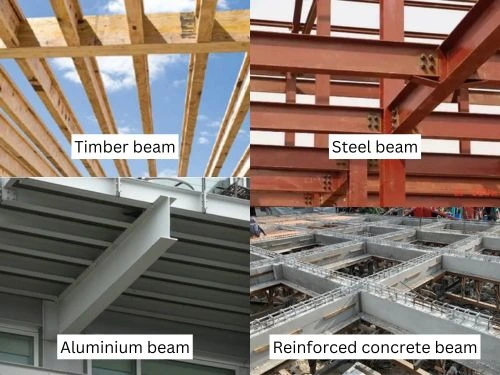
Types of Beams by Material: Timber, Steel, Concrete, and More.
The strength, weight, cost, durability and aptitude of a structural beam depend on its material used. In modern construction, there are six types of beam, which are based on materials.
9. Timber beam:
The oldest material of structural beam, in active use, is timber. Cost effective, simple to install on site, and suitable in medium load requirements in the construction of homes. Its drawbacks include being prone to moisture, being weaker than steel or concrete and prone to biological degradation unless treated.
Real-world use: floor joists and roof rafters in residential buildings, supports in formwork, heritage and renovation.
10. Steel beam:
The heavy load-long span applications are predominantly of steel. The strength-to-weight ratio of steel beams in construction is the best of any structural material commonly used in constructing a building and is perfectly predictable in its behavior, making it much easier to do engineering calculations.
- Real-world use: Frames of high-rise buildings, industry plants, bridges, mezzanine floors, long-span roofs.
11. Reinforced concrete beam:
Concrete is compression strong and tension weak. Tension forces are dealt with by steel reinforcement bars that are embedded into the concrete and compression is dealt with by the concrete. The combination of the two causes reinforced concrete beams to be the most popular type of beam used in building construction in India and most of Asia as both materials are readily available locally and the site labor is familiar with RCC construction.
- Real-world use: Practically all multi-storey residential, commercial and industrial buildings in India.
12. Aluminium beam:
Aluminium beams are lightweight and very resistant to corrosion and are applied where weight is a critical factor or corrosion would be rapid in steel. Not a main type of structural beam in most building construction because of its cost and reduced stiffness but needed in certain environments.
- Real-world use: Marine, coastal, aerospace and defence, some industrial applications with a high chemical exposure.
13. Pre-stressed concrete beam:
The name is a refinement of the reinforced concrete in which the steel reinforcement is tensioned either prior to or subsequent to the concrete being poured. This pre-compression neutralises the tensile forces which would otherwise crack the beam under load making it thinner and less weighty and having a higher span capacity within the same structural depth.
- Real-world use: Bridge superstructures, commerical/parking structure, large floor systems, railway sleeper, large water retaining structure.
14. Composite beam:
Composite beam is a mixture of two or more materials, usually a combination of steel and concrete, to exploit the advantages of each material in a single structural section. Compositely framed with a concrete slab above a steel I-beam, where the two are connected with shear studs, the overall construction is much stronger than any single component.
- Real-world use: Multi-storey commercial buildings where the floor-to-floor height is less of a concern, steel framed structures with concrete deck slabs, long span office floor systems.
Types of Beams by Construction Method: Precast, In-Situ, Post-Tensioned, and More
The method of physically constructing a beam on or off-site influences the project schedule, quality management, cost, and the shape and size that can be attained. This is the type that construction project managers are greatly concerned with, not only structural engineers.
15. Precast concrete beam:
Civil engineers construct these beams before construction and transport them to the site where the architectural project is taking place.
16. In-situ concrete beam:
These beams are poured directly at the construction site. This process involves setting up the formwork, placing reinforcement bars (rebar), and then pouring the concrete. These beams can be shaped to meet specific requirements, but they need time to cure. They are useful for customised fits.
17. Post-tensioned concrete beam:
The concrete Post-tensioned beams have steel tendons (cables) in the beam which are tensioned after concrete has hardened to design strength. The compressions of the tendons cause the concrete to be in pre-compressed condition, which makes the beam highly resistant to cracking and enables the beam to have a longer span with a smaller structural depth.
- Real-world use: Parking buildings, bridge decks, long-span floor systems in commercial buildings, transfer beams with heavy column loads.
18. Lintel beam:
The structural element is a lintel beam that is located above all the door and window openings to support the weight of the wall and structure above the aperture. The masonry above the openings would otherwise be unsupported and would form diagonal cracks, or in extreme instances, fall in around the opening, in the absence of lintels.
- Real-world use: All door frames and window frames of a masonry or load-bearing wall building. It is the most common type of beam in building construction in sheer number, although it is not often included in the same category as primary structural beams.
Types of Beams by Shape: I-Beam, T-Beam, C-Beam, L-Beam, and More
The cross-sectional form of a beam will define its efficiency in the material use. The various shapes of beams are optimized to different directions of loads and structural situations. The choice of shape not only influences structural performance, but also connection detailing, cost of fabrication, and local market sizes.
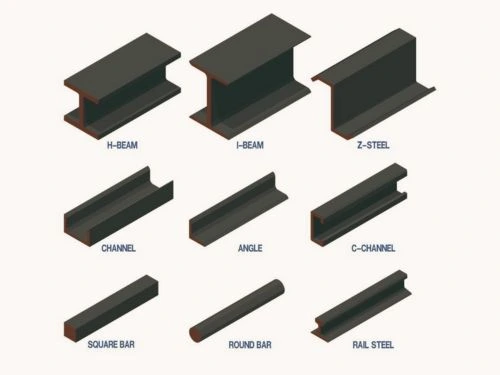
19. I-beam and H-beam:
The best known structural beam profile in the world. The I or H shape locates the majority of the material to the top and bottom flanges, which are the locations of the greatest activity of the bending stress, and utilizes very low levels of material in the web between them. This renders I-beams and H-beams exceptionally effective in bending loads.
Real-world use: Commercial buildings made of steel frame, industrial structures, bridges, crane rails, mezzanine floors.
20. T-beam:
A T-beam consists of a wide flange at the top and a smaller web at the bottom forming a T profile. In reinforced concrete construction the top flange of a beam is frequently the floor slab above the beam, so that concrete and beam together form a composite section that has much greater efficiency than a plain rectangular beam.
- Real-world use: Floor systems in multi-storey buildings, bridge deck cross-sections, precast floor systems, concrete floors.
21. C-beam:
The web of a C-beam contains two flanges on the same side creating a C or U profile in cross-section. It is also known as a channel section, is powerful in both bending and torsion, and is handy when the loads are not exactly centered on the web of the beam, as is the case in reality.
- Real-world use: industrial building roofs and walls, steel-framed buildings, lintels, steel construction, staircase stringers, and purlins and side rails.
22. L-beam:
An L-beam (angle section) is a section that supports structurally in two directions perpendicular to each other. The two legs of the L offer bending resistance both vertically and horizontally and this makes it useful at structural corners and edges.
- Real life application: Corner reinforcement at edges of balcony and staircases, edge beam at edges of floor slab, structural members joints in steel construction.
23. Rectangular beam:
The most basic conceivable beam cross-section: a simple rectangle. Simple to construct in concrete, simple to compute and effective in short spans and light to medium loads.
Even in Indian building construction, the overwhelming majority of all beams (both primary and secondary) are made of rectangular section due to the relative material inefficiency of rectangular formwork compared to more complicated shapes.
- Real-world use: Beams used in residential and low-rise commercial RCC structure, consisting either of primary or secondary, or column used as a beam (with a narrow column configuration).
Statically Determinate vs. Statically Indeterminate Beams: Key Differences
One of the engineering questions that are answered by this classification is: Do three equations of static equilibrium allow you to solve them to find all the forces in this beam?
24. Statically determinate beam:
Yes, you can. The equilibrium alone can be used to compute all the reactions, shear forces and bending moments without the material properties or stiffness of the beam. The most prevalent are simply supported beams and cantilever beams.
These are foreseeable, more convenient to design and possess one significant practical value: should a support settle (the foundation begin to sink a little), no extra stresses are generated in the beam.
25. Statically indeterminate beam:
No. Equilibrium equations are inadequate. It has a larger number of supports or restraints than the minimum number, and that implies that you need compatibility equations and material stiffness values to complete the system. In this category are always continuous beams and fixed-end beams.
Why Beam Selection Mistakes Cost Construction Projects Time and Money
Specifying the right structural beam is only half the job. What happens after the specification is where most Indian construction projects lose money.
Where projects actually lose money:
- Precast concrete beams need 6 to 8 weeks of lead time. If that order goes out in Week 10 instead of Week 6, the schedule slips regardless of what the engineering drawing says.
- In-situ beams need formwork, rebar, concrete pours, and curing, all sequenced correctly.
- Post-tensioned beams require a specialist stressing contractor, coordinated only after concrete hits 75% of design strength.
If any of these dependencies is mistimed, late material delivery, a procurement order placed without lead time, a specialist contractor double-booked, you have idle labor sitting on site, a blocked critical path activity, and cost overruns that were entirely preventable at the planning stage.
The real gap in Indian construction projects:
The beam type is selected correctly. The schedule says installation happens in Week 14. But no one tracked whether the procurement order went out in Week 6 to make that possible.
This is the real problem in most construction projects across India, not the choice of beam in construction, but the execution system around that choice.
How NYGGS closes that gap:
This is exactly where construction project management software changes outcomes.
NYGGS’s construction ERP software consolidates procurement planning, material tracking, and site progress into a single system that gives project managers real-time visibility into:
Whether structural beam procurement is on schedule
- Whether deliveries are confirmed against the construction timeline
- Whether installation sequences match the engineer’s curing or stressing requirements
Teams can set automated procurement alerts tied to the project schedule and catch beam installation risks before they push the handover date.
Conclusion
Choosing the right type of beam is not a single decision. It is a cascade of decisions about structural load, available materials, site conditions, environmental exposure, and project budget. The 25 types of beams in construction covered in this guide, classified by support, material, construction method, shape, and equilibrium behavior, give you the complete picture of what is available and when each beam type is the right tool for the job.
For structural engineers, this guide provides a structured reference across all classification systems. For construction project managers and site supervisors, the more important takeaway is that the beam type chosen by the engineer has direct consequences for your procurement timeline, your material schedule, and your on-site construction sequence.
Managing those consequences systematically, rather than reactively, is what separates projects that finish on time from those that do not.
Want to see how NYGGS’s construction project management software helps teams track beam procurement, material deliveries, and construction sequencing from a single dashboard? Contact NYGGS today for a free demo.
FAQs
Q. How many types of RCC beams are there?
A. There are three types of reinforced concrete beams: Single-reinforced beams, Double-reinforced beams, and Flanged beams.
Q. How many types of I-beams are there?
A. There are two standard I-beam forms:
- Rolled I-beam, formed by hot rolling, cold rolling, or extrusion, depending on the material.
- Plate girder, formed by welding (or occasionally bolting or riveting) plates.
Q. What is the strongest beam type?
A. Beam strength depends on materials and design. Steel-reinforced beams are very strong and can carry a lot of weight, making them one of the best options for construction. However, it is best to ask an engineer which type of beam is suitable for your project.
Q. Are beams and pillars the same?
A. No, beams and pillars are not the same. Beams are horizontal or sloping and bear the load. Pillars or columns are vertical and support the beams.
Q. Which type of beam is economical?
A. Simple supported beams are often the most economical choice for small to medium-span structures. They are easier to build and use fewer materials.