



Business today is warfare. You need every advantage you can get to survive the market. And one of those advantages is implementing the right ERP.
But you aren’t just looking for software. You are looking for a way to stop the chaos. You want a tool that can be at the centre of this battle as your operational backbone. If your backbone is weak because of scattered spreadsheets, disconnected departments, guesswork or whatever else – you will struggle to stand upright. This is why ERP implementation is the single most critical task that must be carefully done.
Implementation of ERP is more than just software installation; it’s a strategic transformation. When implemented correctly, it can transform a sluggish organisation into a lean, data-driven machine. If done incorrectly, however, it can become a black hole for money.
This guide is your field manual. We will remove the jargon and examine the ground reality of implementing an ERP system.
What is ERP Implementation?
Imagine your company is like a school. Maybe right now, each class works alone – no sharing. Finance? They’re clueless about sales moves. Stock levels? Just hoping they guess what production wants.
ERP (Enterprise Resource Planning) is the smart campus that connects everything.
And ERP implementation is the process of building that campus. It is not just buying the licence; it is the act of configuring, moving data, and training people to fit a unified system.
Why go through the trouble?
- Efficiency: You automate repetitive tasks like invoice generation and creating reports.
- Real-Time Insights: You have every second information on what department is doing what.
- One Truth: “It’s like moving from scattered notebooks to one smart dashboard.”
According to recent data, organisations report massive wins after implementation: 78% improve productivity, and 76% boost interactions with suppliers.
ERP Implementation Life Cycle
You cannot simply “switch on” an ERP. You must nurture it.
The journey of your software starts fresh every time – it’s what we call its “life cycle.” This means you don’t just install it and forget it but continuously optimise it. A structured life cycle also ensures that problems pop up less often and things stay steady.
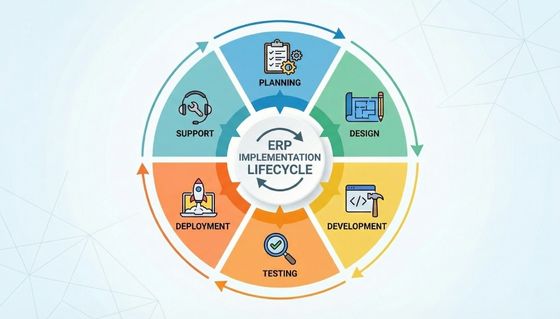
Once you hit Support, the wheel doesn’t stop. You optimise, you update, and you plan again. This cycle ensures structured success rather than random acts of IT.
ERP Implementation Methodology
How do you eat a burger? One bite at a time? Or do you try to swallow it whole?
The same logic applies here: your methods of ERP implementation are your roadmap. Choosing the wrong one is a disaster waiting to happen. Usually, the Big Three Approaches are:
1. Big Bang (All at Once):
In the ERP implementation approach, everything switches to the new system at once. This is like you switch off the old system on Friday and launch the new one on Monday everywhere. It is a high-risk, high-reward method. Only 21% of organisations use this today. And it requires massive preparation.
2. Phased Rollout (Step-by-Step):
You launch the Finance module first. Then HR. Then Supply Chain. So this ERP implementation method introduces the system department by department. And this is considered safer and more manageable. Data also backs this, as more than 50% of organisations choose this path. It allows you to fix mistakes as you go, but the total ERP implementation time could be longer.
3. Parallel Adoption (Safety Net):
In this approach, old and new systems run together for a while. This is because users get time to learn the new system, and the old system acts like a safety net. This method is very safe but doubles the work for your staff and can be costly and confusing at times.
Pro Tip: Rome wasn’t built in a day. With the same philosophy, a phased rollout is the wisest choice for most Indian SMEs and growing enterprises. It balances speed with safety. Because trying to build your ERP in a day can destroy your operations.
The 7 Stages of ERP Implementation
Here is the heart of the blog. This is your checklist for a smooth ERP implementation.
1. Planning
“Failing to plan is planning to fail.”
Most projects fail before the software is even installed because the planning was weak. This phase sets the foundation for success. As the first phase in ERP implementation, you need to go beyond “wanting new software” to getting clear in your head about “whys”. List the answers to questions like:
- Are you seeking to reduce operational costs?
- Want an efficiency boost?
- You would like to gain real-time visibility?
- Wish to automate tasks and make your operations advanced?
Setting your budget is also crucial in ERP implementation planning. It’s way more than just buying the software. You will also have to think about hardware upgrades, data migration costs, training, charges for potential customisations, and crucially, a contingency fund for the inevitable unforeseen challenges. Get clear on what it’ll really cost (Total Cost of Ownership or TCO) several years, not just at first.
Remember that “Well begun is half done.”
2. Design
This is where abstract goals begin to take concrete form. You have to map current and future “to-be” workflows (e.g., order-to-cash, procure-to-pay, direct-pay-to-vendor). Document every step. Identify pain points for which you want solutions. This step becomes easier when you involve end-users in design, as their insights are crucial for usability, adoption, and avoiding costly redesigns.
3. Development
When the design is done, it’s time to set up the ERP system. And if necessary, you have to think about customising. Ask your ERP vendor to add custom fields and rules that are unique to your business requirements. Yet don’t over-customise your ERP. As the saying goes – too many cooks spoil the broth – Too much tailoring makes updates harder, raises upkeep costs, and leaves behind messy code. Shape your workflow around what the tool does well instead of copying outdated methods.
4. Data Migration
Transfer critical historical and current data from old systems (old databases, Excel sheets, and paper) into the new ERP. This stage is often underestimated but is one of the most difficult phases in ERP implementation. Give this step sufficient time to be completed properly because data is the new oil for a business to be on track. But if your oil is dirty, it will destroy the engine.
5. Testing
Once successful data migration happens, this is the time to identify and rectify errors before go-live. Actively test to make the system fail under various conditions: edge cases, incorrect inputs, high volumes, and concurrent access. Conduct unit, integration, and performance testing. In the ERP implementation testing stage, break the system before it breaks you. The better way to test is to run “Day in the Life” scenarios. For example, you can run full order cycles with dummy users and see how smooth or unsmooth the ERP was. User Acceptance Testing (UAT) ensures intuition, efficiency, and meets business requirements.
6. Deployment
Whew! Months of planning, designing, putting things together, then checking everything – now we’re finally moving off the old setup onto the new ERP. Low-activity periods are the ideal time for this transition with a hyper provisioning.
One advice as an ERP vendor in India: Expect initial chaos. The system may face glitches and your teams may get overwhelmed. But this turbulence can be overcome with robust support and timely problem resolution. Just keep in mind that change is hard at first, messy in the middle, and gorgeous at the end.
7. Support & Training
The ERP implementation isn’t over at go-live. This is when the real work starts. To maximise ERP ROI, get more people on board and make the system work better every day. Set up a special team, like help desks or super users, to handle problems after launch. Keep making upgrades by listening to what users say, then use that info to tweak and grow the setup. If things are getting harder, consider engaging a dedicated software consultant or implementation partner and achieve an 85% success rate. External expertise provides profound value by cutting through confusion, reducing risks, applying best practices, and handling change management – making ERP software worth every penny.
Best Practices for Smooth ERP Implementation
To make ERP implementation successful, companies need to:
- Get Strong Leadership Support: When they’re into it, others follow. Not just talk but show up regularly; actions matter more than words.
- Train Employees from Start: A stitch in time saves nine. Spend time training users before go-live, not while they are struggling to ship an order.
- Communicate Clearly with Employees: “Technology is best when it brings people together.” So tell people why this is happening.
- Focus on the “First 30 Days of Hell”: The month after go-live can be the “V-shaped dip”. Productivity will drop while people learn. Prepare for this. Have extra support staff on hand.
- Monitor KPIs, Monitor Success: Measure what matters, and track who’s faster at adapting or who’s giving fewer errors.
Conclusion
ERP implementation is a full-on business transformation. For proper implementation, all 7 stages matter. And when companies get it right? The payoff is huge.
In fact, 91% of organisations that stuck with ERP for a year or more saw optimised inventory levels. Plus, the ripple effects are massive: 78% boosted productivity, 77% broke down silos, 76% improved supplier interactions, 75% nailed compliance, and 70% delivered better customer experiences.
Bottom line: ERP implementation takes patience and the right partner. NYGGS can help you cut through the complexity and unlock those results faster.
 Ready to transform your business? Schedule a call with an expert today.